
By: Princess del Castillo
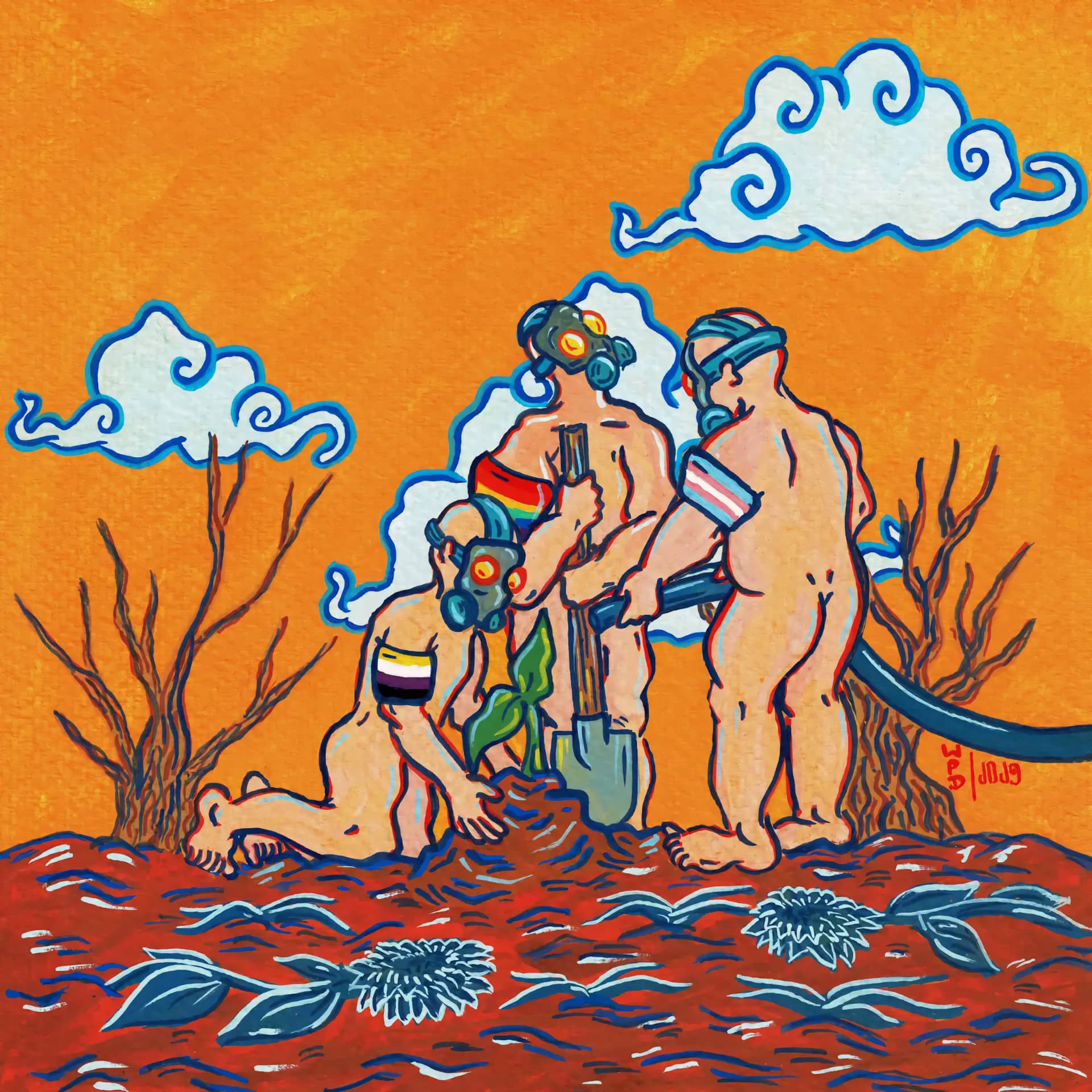
"Build a better future" by Erik (IG: @wetpaint_dreams)
Southeast Asia stands at the frontlines of an escalating climate crisis. Rising temperatures, intensifying typhoons, worsening floods, prolonged droughts, and slow-onset changes are reshaping lives and deepening inequality. These impacts, however, do not fall evenly. They are filtered through pre-existing systems of power that decide who is protected and who is pushed to the margins.
Yet one truth remains glaringly absent in regional climate discourse: LGBTQIA+ people are disproportionately affected but rarely recognized, protected, or included.
This article challenges that silence. It explains why queering climate justice is urgent and necessary, and why the Queer Climate Justice Manifesto marks a critical intervention from communities long excluded from climate policymaking.
Lived Realities: When Discrimination Meets Disaster
Across Southeast Asia, queer and trans people navigate daily discrimination in housing, employment, healthcare, and public safety. When climate disasters strike, these inequalities do not pause; they intensify.
Local stories across the region reveal a painful pattern: resilience shaped by ingenuity, but survival made harder by stigma and exclusion. In Myanmar, queer individuals displaced by floods and storms face extreme housing insecurity, crowding into small rented rooms with little external assistance. In Borneo, Indonsia, transmen are denied recognition of their gender, blocking them from appropriate relief goods and safe services.
Across the region, stories reveal systemic discrimination in the face of hardships. Trans people are denied entry into evacuation centers because their IDs do not match their gender presentation. LGBTQIA+ couples and chosen families are excluded from relief systems built around heterosexual, nuclear households. Segregation and discrimination in temporary shelters result in queer people receiving less assistance and inadequate health support. Post-disaster economic instability pushes some LGBTQIA+ people into precarious or informal work, including sex work, to survive. Evacuation centers rarely safeguard privacy, exposing queer people to harassment, scrutiny, and exclusion.
These stories are not isolated incidents, they form a regional pattern.
They remind us that climate impacts do not occur in a vacuum. They collide with discrimination already embedded into everyday life.
Climate Injustice: The Unequal Burden of Crisis
The lived realities above point to a broader truth: climate injustice is an outcome of oppressive systems. It is not only about who experiences climate impacts first, but about who suffers the most because of the systems shaping society.
Climate injustice emerges from:
- capitalism and extractivism, which prioritize profit over people and land;
- patriarchy and heteronormativity, which define whose families count and whose do not;
- authoritarian governance, which limits civic space and silences marginalized voices;
- class inequalities, which restrict access to basic services and disregard the dignity of the poor.
These systems determine who is evacuated, who receives relief, who has safe shelter, who gets recognized, who gets left behind.
This is climate injustice: when those already marginalized are pushed even deeper into vulnerability, denied protection, dignity, and the right to exist safely.
Climate injustice is built and reproduced through political, economic, and social structures that privilege some lives over others. Understanding this is essential in designing climate responses that do not repeat or reinforce the harms already experienced by LGBTQIA+ communities.
What It Really Means to Queer Climate Justice
Queering climate justice is not a side issue or a special-interest concern. It is a necessary political project that strengthens climate responses for everyone.
Before describing what queering climate justice looks like, we must acknowledge the dominant systems that shape today’s climate actions. . Governance across the region continues to enforce rigid gender norms, with social policies built around an “ideal family” that excludes chosen families and erases diverse identities, an expression of institutionalized heterosexism and the gender binary.At the same time, democratic systemic backsliding has widened, silencing dissent, spreading climate disinformation, and shrinking civic space. And to cap these, there are exclusionary development models that place extractive corporate interests above human dignity.
To “queer” climate justice is to disrupt these defaults.
Queering climate justice means:
- Challenging the heteronormative, patriarchal, and capitalist assumptions embedded in climate governance.
- Recognizing that communities and families exist beyond state-sanctioned norms.
- Making visible the knowledge, resilience, and leadership of LGBTQIA+ people who already practice collective care and survival.
- Transforming climate action so it is rooted in human dignity, rights, and lived realities and not as charity or token inclusion.
Queering is an act of liberation. It expands what justice can look like and ensures climate action becomes more humane, equitable, and effective.
Our Collective Vision: The Queer Climate Justice Manifesto
LGBTQIA+ communities, organizations, and allies from across Southeast Asia have come together to assert a clear, principled call through the Queer Climate Justice Manifesto.
The manifesto affirms our existence, our resilience, and our right to shape the climate decisions that directly affect our survival.
It demands:
- Inclusive, people-centered climate policies that safeguard LGBTQIA+ rights, dignity, and safety.
- Transparent, participatory governance where queer and trans communities are equal partners with meaningful oversight.
- Climate finance, DRR, and adaptation programs that prioritize marginalized groups and hold corporate actors and elites accountable for harm.
- ASEAN leadership that turns regional commitments into action grounded in safety, respect, and empowerment, especially for people historically excluded from policymaking.
The manifesto is not only a political statement — it is a roadmap for building climate action that leaves no one behind.
It is also an invitation: to imagine climate futures grounded in justice, safety, mutual care, and shared power.
Why Inclusion Cannot Wait
Southeast Asia is approaching climate thresholds that may soon become irreversible. Without intentional, rights-based climate interventions, existing inequalities, including those rooted in gender identity, sexuality, and economic marginalization, will only deepen.
Invisibility is a form of vulnerability.
When LGBTQIA+ people are not explicitly recognized, they remain excluded from the protections, resources, and decisions that shape climate survival. Inclusion is not an add-on. It is a prerequisite for building effective, humane, and resilient climate governance.
A Call to Action
Queer climate justice is a collective project: one grounded in courage, community, and solidarity. We call on governments, civil society, researchers, donors, and allies across Southeast Asia and beyond to stand with LGBTQIA+ communities in shaping climate responses that protect everyone.
The Queer Climate Justice Manifesto is a step toward that shared future.
Sign it. Share it. Stand with us.
Together, we can advance climate action that protects our rights, affirms our dignity, and ensures no community is left behind.
About the Author
Princess del Castillo is an Environmental Planning and Management graduate with ten years of experience in community development and environmental advocacy. She uses storytelling to spark curiosity about conservation and inspire a deeper appreciation for nature.