
By: Riska Carolina
On 20 September 2026, LGBTQ+ activists, athletes, civil society organizations, sport practitioners, companies, and other stakeholders from across Asia gathered at the Nagoya International Center in Japan for the Asia Dialogue on Sport, Diversity and Society, organized by Pride House Tokyo.
Held in the context of the Aichi–Nagoya Asian Games, the dialogue created a space to discuss a question extending far beyond sport: What does meaningful LGBTQ+ inclusion look like when it is grounded in the diverse realities of Asia?
Sport has a particular ability to bring people together across borders, languages, and cultures. At the same time, sporting spaces do not exist separately from society. They can also reflect inequalities related to gender, sexuality, race, nationality, disability, religion, and other identities.
The Nagoya dialogue therefore used sport as an entry point for a broader conversation about human rights, diversity, discrimination, and social inclusion across Asia.
There Is No Single LGBTQ+ Reality in Asia
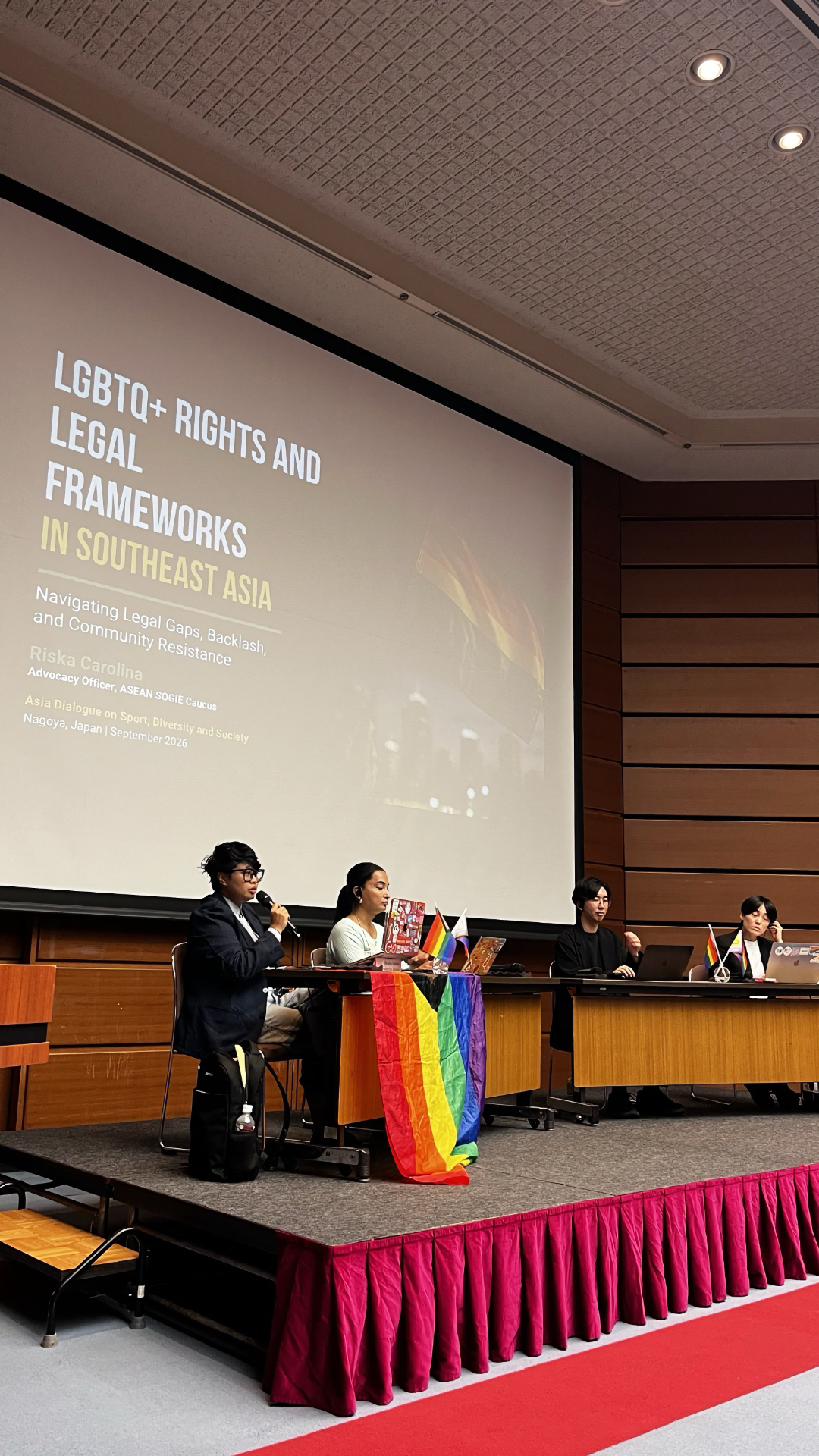
One of the important themes emerging from the dialogue was the need to resist treating Asia as a single, homogeneous context. This was particularly relevant during Panel 2, “Legal Frameworks and LGBTQ+ Rights in Asia: Perspectives from Activists,” which brought together activists from Indonesia and Southeast Asia, Nepal, and Japan to discuss the different legal and policy environments affecting LGBTQ+ communities.
Riska Carolina, Advocacy Officer of the ASEAN SOGIE Caucus (ASC), contributed a Southeast Asian perspective to the panel, focusing on the relationship between law, public policy, social attitudes, and the lived realities of LGBTQ+ people in the region.
Southeast Asia demonstrates significantly different legal and political trajectories. In some jurisdictions, LGBTQ+ communities have achieved important advances in legal recognition and protection. In others, LGBTQ+ people continue to face criminalization, discriminatory policies, exclusion, or the absence of meaningful legal protection.
These differences demonstrate that there is no single trajectory for LGBTQ+ rights in the region. They also show that legal change is neither linear nor inevitable. The discussion further highlighted that law does not operate separately from society. Government policies, political discourse, and legal recognition can influence how LGBTQ+ people are perceived socially. Legal recognition and protective policies can contribute to an environment in which equality becomes increasingly visible and legitimate. Conversely, discriminatory policies and hostile political discourse can reinforce existing stigma and exclusion.
Indonesia was discussed as one example of this relationship. The absence of comprehensive legal protection for LGBTQ+ people exists alongside increasing political and social hostility toward LGBTQ+ communities.
In such an environment, policies and political narratives can contribute to exclusion even when they do not explicitly criminalize LGBTQ+ identities. Narratives portraying LGBTQ+ people as threats to morality, culture, religion, family, or social order can shape both public attitudes and the policy environment. This relationship means that legal advocacy cannot be separated from the broader struggle over how LGBTQ+ communities are represented and understood.
When LGBTQ+ Rights Are Called “Western”
Across different Asian contexts, anti-gender movements increasingly rely on a familiar argument: LGBTQ+ identities, transgender rights, and broader gender equality agendas are supposedly foreign or “Western” concepts. Such narratives can position LGBTQ+ people as outsiders within their own societies.
The discussion in Nagoya therefore raised another question: Whose history is being remembered?
Gender and sexual diversity did not suddenly arrive in Asia through contemporary international human rights movements. Across Southeast Asia, histories and cultural traditions contain examples of gender expressions, identities, and social roles that cannot be understood solely through contemporary binary categories. Indonesia itself contains diverse cultural histories that complicate the claim that there has always been only one fixed way of understanding gender and sexuality.
Remembering and communicating these histories can therefore become part of responding to anti-gender narratives. When LGBTQ+ advocacy is framed exclusively through contemporary legal terminology, movements may find themselves trapped within a binary constructed by their opponents: LGBTQ+ rights are characterized as “Western,” while discrimination is presented as somehow authentically “Asian.”
The discussion in Nagoya demonstrated why this binary should be questioned. Rather than debating whether LGBTQ+ rights belong to the “West” or “East,” movements can draw attention to histories demonstrating that gender and sexual diversity have long existed within societies throughout the region.
Recovering these histories does not mean romanticizing the past, nor can cultural recognition replace the need for legal protection and universal human rights standards. Instead, historical and cultural narratives can complement rights-based advocacy by challenging attempts to portray LGBTQ+ communities as foreign to their own societies.
Grounding LGBTQ+ Advocacy in Asian Contexts
The dialogue also encouraged participants to consider what it means to develop LGBTQ+ advocacy grounded in Asian contexts. There is no single “Asian approach” to LGBTQ+ rights, just as there is no single LGBTQ+ experience across Asia.
Countries throughout the region have different political systems, religions, colonial histories, legal traditions, cultures, and movement strategies. Approaches developed in one context therefore cannot simply be reproduced elsewhere. What can move across borders, however, are experiences and lessons.
Movements can learn from one another about legal reform, responses to political backlash, coalition-building, community mobilization, and strategies for developing narratives that resonate within different societies.
Regional spaces such as the Asia Dialogue are valuable precisely because they allow movements to exchange these experiences without assuming that one model will work everywhere.
This regional exchange is particularly relevant at a time when anti-gender narratives themselves increasingly appear across different national contexts. Strengthening connections between movements can help civil society better understand these patterns while developing responses rooted in local histories and political realities.