
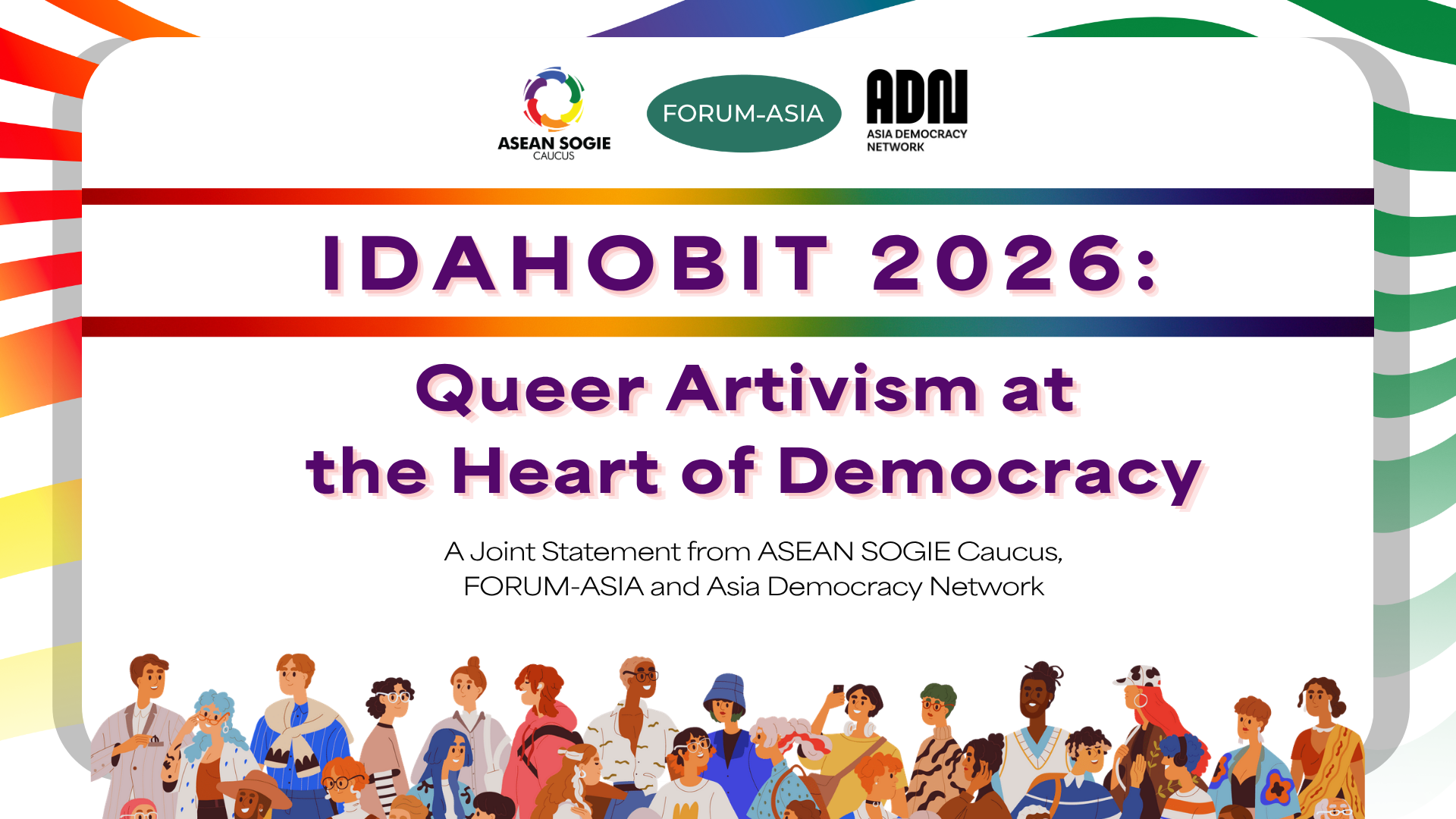
This year’s IDAHOBIT Theme “At the heart of democracy”, reminds us that democracy is not only measured by elections, institutions, or formal participation. Democracy is also lived through freedom to speak, to create, to gather, to dissent, to imagine, and to be recognized as part of the political community. For LGBTQIAN+ communities, expression has never been merely symbolic. To speak our names, tell our stories, perform our truths, reclaim our histories, and create spaces of queer joy are forms of political acts. In contexts where formal political spaces remain inaccessible, unsafe, or exclusionary, art becomes a way to enter public life. Queer artivism allows communities to challenge dominant narratives, resist censorship, build solidarity, and expand the meaning of democracy beyond state institutions.
Democracy must include the right of LGBTQIAN+ persons to be represented and recognized in political affairs, both formally and informally. This means meaningful participation in government processes, lawmaking, public policy, and human rights mechanisms. It also means recognizing the political power of social movements, cultural spaces, community organizing, collective care, and creative resistance. LGBTQIAN+ communities are not passive subjects of democracy; they are active agents shaping democratic futures.
Across Asia, queer artists, cultural workers, activists, and communities continue to create despite increasing threats to freedom of expression. Through festivals, exhibitions, performances, storytelling, digital campaigns, community archives, and collective spaces, queer artivism opens room for dialogue where direct advocacy may be restricted. It allows communities to reclaim histories of gender and sexual diversity, contest colonial, patriarchal, and heteronormative ideas of citizenship, and insist that LGBTQIAN+ lives belong in public memory, public culture, and public decision-making.
At the same time, democracy cannot flourish while public policies continue to criminalize, censor, or erase LGBTQIAN+ identities and expression. Across the region, this can be seen not only through laws criminalizing consensual same-sex relations, but also through media that frame LGBTQIAN+ lives as immoral, harmful, or unfit for public visibility. Recent examples include Indonesia’s draft revision of the Broadcasting Law, which has been criticized for prohibiting content depicting “LGBT behavior”; Malaysia’s use of censorship and publication laws to restrict LGBTQ-related books, films, and cultural materials; Singapore’s continued higher age ratings for LGBT media content despite the repeal of Section 377A; and proposals in the Philippines to expand state regulation over online streaming platforms based on standards of decency, morality, and public order. These policies determine whose stories may be told and whose participation in public discourse is considered legitimate. We therefore reiterate the urgent need to repeal laws and policies that criminalize, stigmatize, censor, or marginalize LGBTQIAN+ communities, and to replace them with systems that protect dignity, equality, freedom of expression, artistic freedom, bodily autonomy, and meaningful participation.
This moment also calls for a deeper and more intersectional approach to democracy. Efforts to defend civic space, human rights, peace, climate justice, gender equality, labor rights, digital rights, and social protection cannot treat LGBTQIAN+ issues as secondary or separate. LGBTQIAN+ persons are part of every struggle for justice. They are workers, migrants, indigenous persons, persons with disabilities, people living in poverty, people affected by conflict and disasters, artists, caregivers, human rights defenders, and community leaders. A democratic movement that sidelines LGBTQIAN+ voices cannot fully claim to be inclusive.
As human rights, democracy, and LGBTQIAN+ movements, we recognize that the struggle for democracy and the struggle for LGBTQIAN+ liberation are deeply connected. Authoritarian and anti-rights forces often attack LGBTQIAN+ communities as part of a broader assault on freedom of expression, civic participation, gender justice, bodily autonomy, and pluralism. Defending LGBTQIAN+ rights is therefore not a niche issue. It is central to defending democracy itself.
On IDAHOBIT 2026, we affirm queer activism as a vital democratic practice. Artivism is not an accessory to advocacy; Artivism is a way to pluralize our political voices as we demand for justice, democracy, and human rights. It reminds us that democracy is not only built in parliaments, courts, and policy rooms, but also in various spaces where people's creative imaginations can manifest freely.
At the heart of democracy is the freedom to exist without fear. At the heart of democracy is the right to be seen, heard, represented, and recognized. At the heart of democracy is the collective work of building societies where no one is pushed to the margins because of who they are, whom they love, how they express themselves, or how they imagine freedom.