
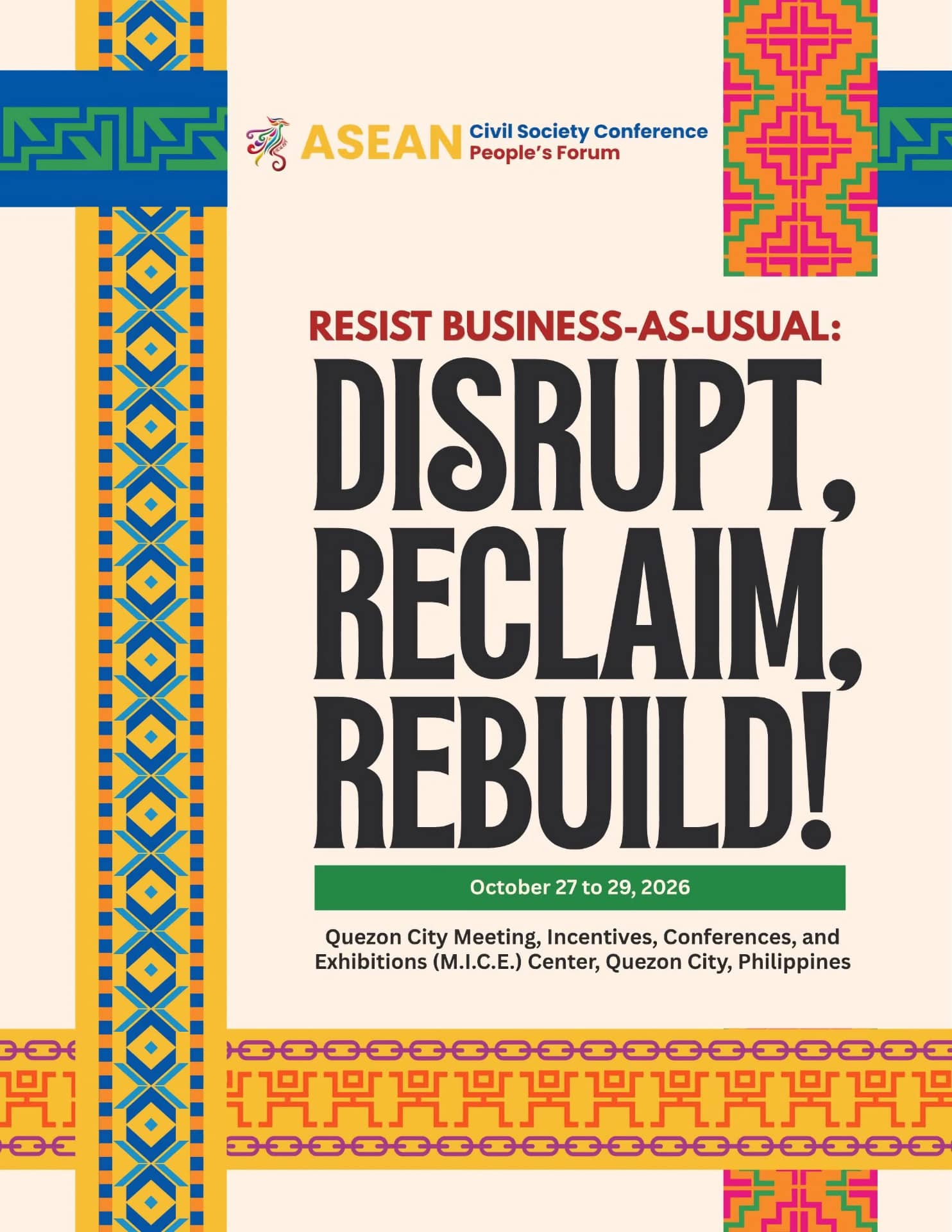
ASEAN Civil Society Conference / ASEAN People’s Forum (ACSC/APF) 2026 Declaration: Resist, Rebuild, Reclaim
The ASEAN Civil Society Conference / ASEAN People’s Forum (ACSC/APF) is a cross-movement and intersectional process co-led by diverse collectives and individuals from civil society, social movements, trade unions, media, and academia. We amplify the lived experiences and wisdoms of marginalized communities: human rights defenders, indigenous groups, ethnic communities, women, children, youth, LGBTQIA+ persons, workers, farmers, fisherfolks, older persons, persons with disabilities (PWDs), unhoused, informal workers, stateless persons, refugees, and other sectors. We envision an inclusive Southeast Asian region that fully upholds human rights, guarantees gender equality, protects climate justice, and promotes meaningful participation of all. We recognize that authoritarianism, corporate exploitation, social inequalities, and patriarchal oppression interact systematically to suppress civic spaces, undermine democratic values and institutions, threaten human security, and erode fundamental freedoms across the region.
To "Resist Business As Usual" is to radically disrupt and redefine the status quo of the “ASEAN Way” of non-interference, quiet diplomacy, and consensus decision making that systematically excludes civil society, environmental priorities, and public accountability. Our resistance rejects the patriarchal, homophobic, and transphobic structures and narratives that poison our principles, policies and practices; we reject the structural violence that denies us access to the halls of power and devalues care work as a secondary concern. We are here to disrupt this extractive, harmful status quo. Genuine democracy and social justice cannot be achieved in the neoliberal system of privatization, war economy, weaponization of the legal system against civil society organizations (CSOs) and communities, and the commodification of the human rights agenda. We demand a clean break from the neoliberal and imperialist-led economic framework that treats our communities as disposable and our ecosystems as bottomless pits for profit accumulation.
We reclaim an ASEAN that fully belongs to the people, rooted in gender justice, ecological integrity, and the sovereignty of the public over autocratic and neoliberal interests. A people-centred region requires establishing strong and reliable mechanisms of accountability to prosecute state atrocities, halt the dispossession of our lands, and end the reign of extractive structures and cultures that violate both human rights and the sanctity of our biodiversity.
The Southeast Asian region is experiencing a profound polycrisis, where ASEAN, as an intergovernmental organization, is being used to serve the autocratic and capitalist interests, most of whom have blood on their hands. Digital authoritarianism, state-sponsored disinformation, cyber-monopolies, and transnational surveillance have become tools to attack on democratic institutions, social cohesion, and frontline defenders.
The aggressive destruction of the environment has exacerbated complex disasters, such as the transboundary haze, that threaten health and lives. The hyper-capitalist regime, spreading and dominating rapidly across the region, depends on the violent actions of States to criminalize environmental rights defenders, militarizing and legitimizing the criminalization of their activities in favor of capital, demonstrating that corporate impunity destroys both democratic governance and social justice. We call for the immediate, unconditional phase-out of fossil fuels and the total removal of extractive projects from our most vulnerable landscapes. We reject the narrative that nuclear energy is inevitable towards development, and particularly as a mandatory solution to the energy crisis. Anchored on the principle of “do no harm”, we reject massive geoengineering and instead call for equitable and just climate solutions.
We demand a radical protection of human rights and the environment against the interests of states and imperialist powers. We call for a rights-based, people-centered, redistributive, and decolonial governance of natural resources, including minerals. We resist all forms of oligarchy by reclaiming people’s democratic control over natural resources, governance, development, and our lives.
We reiterate our commitment to democracy and respect for self-determination. As in the previous ACSC/APF, we reject any form of political recognition of the Myanmar military junta. We urge ASEAN to recognise democratically elected officials of the National Unity Government (NUG), to establish effective redress mechanisms to address all forms of human rights violations and atrocities committed by the genocidal military junta against Myanmar’s people, and to cut off the aviation fuel supply chain, and economic ties with the Myanmar junta. Bombings, the burning of homes, grave human rights violations, and forced conscription have displaced more than 4 million people inside the country and forced at least 5 million to flee to ASEAN countries. Myanmar's genocidal military junta is committing war crimes, including relentless airstrikes on civilians, in blatant violation of International Humanitarian Law (IHL), and continues to ignore ASEAN's Five-Point Consensus (5PC). We support the struggles for the right to self-determination and towards lasting peace and justice in Myanmar (Burma), West Papua, and Occupied Palestine.
We are here to dismantle the status quo and replace it with a region-wide solidarity that centers people's aspirations, gender justice, and the non-negotiable protection of the Earth. Since climate breakdown and economic austerity predominantly affect diverse marginalized groups, climate justice should be based on redistribution of social reproductive labor, respect of bodily autonomy, and guaranteed social protection.
We are collectively reclaiming and transforming the ASEAN space into a borderless and intersectional platform of rights-based democratic governance and social justice. We aren’t asking for change; we are building the alternatives ourselves. To go beyond mere resistance and build lasting counter-power in Southeast Asia, civil society should rethink and sustain regional solidarity towards an alternative regionalism. We collectively express our concerns and recommendations to ASEAN, relevant governments, the donor community, and all stakeholders.
1. Digital Rights and Internet Freedom
- ASEAN Member states must protect fundamental rights online by reviewing restrictive cybersecurity, defamation, counterterrorism and public order laws in accordance with international human rights standards. Safeguard freedom of expression, peaceful assembly and association, particularly for vulnerable communities and human rights defenders. End arbitrary censorship, internet shutdowns, VPN bans, unlawful surveillance, unlawful digital surveillance, red-tagging, doxxing, inauthentic or paid buzzer campaigns, and criminalisation of peaceful activism. Ensure accountability for violations and protect activists from persecution.
- Strengthen digital governance through enforceable regulations on data privacy, consumer protection, platform workers’ rights, online fraud and gambling, alongside accessible complaint and redress mechanisms. Invest in digital literacy, inclusive infrastructure and community-based digital services. Impose a moratorium on the sale and use of commercial spyware until binding human rights safeguards are in place. Establish regional minimum standards for digital rights, corporate accountability, environmental protection and responsible technology use, supported by effective monitoring and enforcement mechanisms.
- Preserve national regulatory autonomy under the Digital Economy Framework Agreement (DEFA) and related agreements, including authority over digital platforms, data, telecommunications and foreign investment. Promote domestic industries and responsible management of critical resources. Ensure transparency and meaningful public participation in DEFA negotiations and other regional agreements by publishing draft texts and impact assessments, and incorporating grassroots communities’ contributions before adoption.
- ASEAN should develop a regional framework on platform accountability. It should require technology companies to have a human rights-based and transparent content moderation, to offer timely appeals, to publish transparency reports on government-led data requests and takedown, to include data protection authorities, and to establish cross-border redress mechanisms for data breaches.
- ASEAN Member States should make sure marginalized groups take part meaningfully in digital governance and policymaking, including ASEAN digital policy processes. They should close the digital divide in rural, remote and conflict-affected areas, and respect Indigenous and ethnic data sovereignty and community-led documentation.
- Complementary roles of digital and physical activism, including community engagement and enabling women, girls, and marginalized groups to express their own issues when engaging with stakeholders.
2. Food Sovereignty, Climate Justice & Environmental Rights
- On Just, People-Powered Transition
- ASEAN member states must maintain national control, process minerals domestically to advance democratic industrialization, and collectively establish a list of industries, specifically military and dirty energy industries, that are prohibited from being supplied by transition minerals to ensure economies serve people rather than corporate profit or continued militarization.
- Enforce legally binding safeguards for mineral extraction and the energy transition to prevent pollution and the destruction of ecologically sensitive areas with designated “No-Go Zones”.
- Prioritize energy efficiency and community-led, risk-free renewable alternatives (wind, solar, geothermal) aligned with international human rights standards and respect local governance by supporting initiatives like the Morong Non-Nuclear Zone Ordinance against national executive fiat. Demand an immediate halt to the fast-tracking of regional nuclear projects, to ensure that no facility is approved until a fully operational, independent regulatory framework is active, comprehensive safety assessments are complete, and Free, Prior, and Informed Consent (FPIC) is rightfully obtained from affected communities.
- Advance People-Centred Mineral governance and ensure that transitions are not only low-carbon but also rights-based, redistributive, and decolonial in undoing long-running Northern dominance in mineral extraction. Global South national control over minerals must be upheld and mineral processing must be used to advance democratic industrialisation and ecological sustainability for the people rather than corporate profit or continued militarisation.
- Ensure Free, Prior, and Informed Consent (FPIC) before any project permit is granted, backed by consistent human rights and environmental safeguards, accessible referral mechanisms, and practical rights guidance.
- On Protecting People’s Rights
- Formally recognize and fund smallholder farmers, women, youth, Indigenous Peoples, ethnic communities, and displaced communities as essential frontline actors and decision-makers and meaningfully integrate them into national climate strategies/regional climate justice planning.
- Guarantee absolute justice and safety for communities and environmental defenders resisting destructive mining and enact binding anti-SLAPP protections to end corporate criminalization and retaliation against land and water defenders.
- Require mandatory corporate accountability, independent environmental monitoring, and effective remediation for environmental and livelihood damages.
- Uphold the Rights of Nature as a legal framework for protecting the environment and as a political framework for innovatively and emancipatorily reimagining rights and access to justice.
- On Food Sovereignty and Agroecological Transformation
- Demand an immediate freeze to agricultural tariff cuts, review and amend import liberalization laws such as the Rice Tariffication Law of the Philippines and restore quantitative import protections during domestic harvest peaks.
- Call for mandated farmgate floor prices for staple crops that guarantee farmers a living margin above the cost of production.
- Direct state resources away from synthetic chemical subsidies toward farmer-led seed-saving networks, cooperative bio-fertilizer production, and decentralized, farmer-to-consumer solidarity food terminals that cut out predatory middlemen.
- Establish a national and regional legal framework for land use and agroecology to provide the guideline for agricultural extension, research, and public finance, while strictly banning corporate enclosure of communal waterways, watersheds, and prime food basins.
- Demand the strengthening and re-establishment of state-owned public grain procurement and establish public food reserves and strategic logistics infrastructure, and ensure that smallholders, rural women, and artisanal fishers are represented in agriculture and food policy decision-making at all levels.
- Complete a comprehensive and meaningful Agrarian Reform Program. Distribute land to dismantle land concentration, land inequality, and corporate dispossession affecting small farmers, rural workers, and food producers.
- Immediately halt forced evictions, land acquisitions, and criminalization/intimidation of land and environmental defenders driven by plantation expansion, infrastructure, forestry, and mining.
- Enforce the "Polluter Pays" Principle and ensure that corporate polluters are financially and legally liable for environmental destruction, extractive industrial disasters, and emissions.
- On Upholding Economic Sovereignty
- Protect national sovereignty and democratic accountability by requiring full transparency, public disclosure, genuine public consultations, and independent assessments of the human rights, environmental, climate, and national security implications of geopolitical, trade, and strategic resource agreements, explicitly including the Philippines–US Pax Silica agreement.
- Redirect transition finance away from expanding resource extraction and toward restoring damaged ecosystems and supporting sustainable, existing community livelihoods, such as reef restoration, seaweed farming, fisheries, and rice farming.
- Deliver climate finance to frontline communities primarily as grants rather than debt-based loans that deepen the vulnerability of those least responsible for the crisis. Secure an ASEAN consensus to advocate for a UN Framework Convention on Sovereign Debt to establish a fair multilateral debt-resolution mechanism that gives indebted nations an equal voice.
- Dismantle Investor-State Dispute Settlement (ISDS) mechanisms and secretive trade tribunals to reclaim sovereign power over lands and resources.
- Counter opaque trade arrangements and imperialist plunder by advancing a People’s Trade Agenda that prioritizes peoples' rights over corporate profits, protects Southern sovereignty, and reorients rules toward climate, economic, and social justice.
- On the transboundary haze pollution
- ASEAN Member States should strengthen the implementation of the ASEAN Agreement on Transboundary Haze Pollution, improve early-warning systems, and coordinate timely responses to forest and land fires, including peatland fires in Borneo.
- ASEAN should prioritise the right to life, health, and livelihoods of marginalized groups disproportionately affected by fires and haze, ensuring access to information, public health support, and effective remedies.
- ASEAN should promote transparent and participatory monitoring and reporting on fire hotspots and burned areas, and their public health impacts, and on the accountability of corporations.
- ASEAN member states should develop recommendations, standards, and guidelines for responding to disasters and other ecological impacts, with the involvement of vulnerable groups and young people. ASEAN should also encourage member states to review policies that contribute to deforestation, harmful mining practices, and unsustainable environmental governance.
3. Labor Dignity, and Migration
- ASEAN Member States must end union-busting, anti-union discrimination, and the repression of trade unionists and human rights defenders; guarantee freedom of association, collective bargaining, and the right to organise; and ensure workers’ meaningful participation in policymaking. Guarantee decent work, living wages, secure employment, and universal social protection for all workers, regardless of employment status or nationality.
- ASEAN Member States must reject austerity, privatisation, and corporate capture of essential public services, and ensure adequately funded, accessible, and quality public services and care systems, with sufficient staffing, decent working conditions, and full labour rights for public service, care, and migrant workers.
- Advance gender equality by recognising, reducing, and redistributing unpaid care work, investing in public care infrastructure including diverse women and girls health and wellbeing, and implementing effective care policies.
- Guarantee migrant workers’ rights through fair and ethical recruitment, protection from exploitation and trafficking, equal treatment, and access to decent work and social protection.
- ASEAN must actively disband Scam Centers & Anti-Trafficking efforts, as well as Launch regional anti-trafficking task forces to target forced labor scam centers that exploit women and youth. Member states must ratify and implement the 1951 Refugee Convention and its 1967 Protocol to provide a minimum standard of legal protections and human rights guarantees in the bloc.
4. Corporate Accountability and Human Rights
- Uphold indigenous and ethnic peoples’ rights to free, prior and informed consent (FPIC), particularly in energy and development projects affecting their lands, territories, resources, and communities; their meaningful engagement in community-based monitoring and information systems; and the data sovereignty and right to self-determination.
- Implement immediate mandate human rights and environmental due diligence (mHRDD), especially in conflict- and disaster-affected areas through regional and domestic legal standards that apply across supply and value chains, and make it an absolute condition for accessing capital, banking, public procurement, and cross-border investments. Corporations must ensure full supply chain transparency.
- ASEAN member states and companies must cut all ties with the Myanma Petrochemical Enterprise (MPE), which supplies the aviation fuel used in the junta’s airstrikes. Cease all financial and economic ties, end all revenue-sharing agreements, and end ASEAN’s role in the aviation fuel supply chain to the junta.
- ASEAN member states must enforce sanctions against the Myanmar junta, including Myanma Oil and Gas Enterprise (MOGE) and Myanma Foreign Trade Bank (MFTB).Thai companies PTT and Gulf Petroleum Myanmar (GPM) must divert all gas payments into a protected escrow account to ensure that the junta cannot access or misuse these funds.
- Strengthen regional cooperation on transboundary harm and access to remedy by setting up a legally binding framework on transboundary harm, and a regional court to address transboundary environmental and health harms and business complicity in conflict and humanitarian crises, enhancing legal and judicial cooperation.
- Intensify cross-border monitoring and investigations, and review the mandate of the ASEAN Intergovernmental Commission on Human Rights (AICHR) with regard to protection from violations committed by state and non-state actors.
- Enforce corporate accountability and hold both state and non-state actors, including international financial institutions (IFIs), that contribute to environmental destruction, land and resource grabbing, and community dispossession.
5. Peace, Human Rights, and Human Security
- Implement all legally binding regional instruments notably the Treaty of Amity and Cooperation, and the ASEAN Nuclear Weapons Free Zone Treaty.
- Leverage the Treaty of Amity and Cooperation as a guide to peaceful settlement of disputes, including that between China and different ASEAN member states, and ensure that civil society and affected communities meaningfully participate in spaces for dialogue and peacebuilding.
- Engage constructively and in good faith in the negotiations towards a legally-binding Convention on Crimes against Humanity, and in the process pursue binding elements that guarantee gender inclusion, that victims and survivors are centered, that fundamental human rights including the right to truth are protected, and that enables creation of monitoring, implementation, and enforcement mechanisms.
- Do not recognize Min Aung Hlaing as President of Myanmar in any form. Refrain from any dialogue with the Myanmar junta led by Min Aung Hlaing until the junta stops all airstrikes and violence against civilians, releases all political prisoners, and fully implements ASEAN’s Five-Point Consensus (5PC). Do not invite Min Aung Hlaing or his Foreign Minister to any ASEAN meetings, including upcoming summits and ministerial meetings.
- End business-as-usual diplomacy with the junta led by Min Aung Hlaing, whose actions are actively worsening regional instability, and support coordinated, cross-sector civil society efforts to disrupt this trajectory.
- Support cross-border humanitarian aid through community-based networks that can reach displaced people, and deliver aid in partnership with the democratic resistance, ethnic stakeholders, and civil society, not through the Myanmar junta in Nay Pyi Taw, which is the perpetrator of atrocities, war crimes, and genocide.
- Strengthen domestic and regional human rights safeguards and accountability mechanisms, including the ASEAN Intergovernmental Commission on Human Rights (AICHR) and national human rights institutions (NHRIs), mandated to address gross human rights violations, both ongoing and those that took place in the past, to provide remedies for victims and survivors, to safeguard civic spaces, to protect human rights defenders from all forms of attacks and reprisals, to ensure fair trials, to prevent arbitrary and disproportionate sentencing, and to work towards the abolition of the death penalty.
- Commit to enacting and implementing comprehensive Human Rights Defenders Protection Laws that are consistent with international human rights standards, and that guarantee safety, security, and redress for all HRDs.
- Strengthen regional cooperation and public monitoring to protect defenders at risk and ensure that victims, survivors, refugees, and affected communities have meaningful avenues for protection and justice, regardless of nationality or the political circumstances in which violations occur.
- Implement the ASEAN Regional Plan of Action on Women, Peace and Security, emphasising the leadership and participation of women in peace processes, in victim assistance, and in unexploded ordinance (UXO) clearance.
- Work towards an ASEAN Youth, Peace and Security framework in a collaborative manner with youth from diverse backgrounds, and with an intention to institutionalize youth-led peacebuilding and healing, victim or survivor centered healing, vocational training, cross-border youth exchanges, and protection of civic spaces.
- Enhance solidarity across ASEAN civil society through collective action, including coalition-building, empathy workshops, and multi-stakeholder collaboration, to counter hate speech, raise public awareness, and find common ground.
- Guarantee a durable, lasting and just peace and demand an end to the ongoing genocide in Occupied Palestine by ensuring an immediate and durable ceasefire, and safe and unhindered humanitarian access to all affected civilians; condemn and express grave concerns on gross or serious violations of international law; end impunity by both state and non-state actors; and fully recognize the right to self-determination of the Palestinian people.
6. Displacement & Statelessness
- Uphold every person's right to a nationality and protection from arbitrary deprivation of nationality as enshrined in the ASEAN Human Rights Declaration, including children as enshrined in the United Nations Convention on the Rights of the Child.
- Guarantee stateless and refugee persons' equal access to essential rights and services including access to education at all levels, affordable healthcare, right to work and financial services.
- Establish a regional statelessness protection and cooperation mechanism upholding the human rights of stateless persons, including stateless refugees, refugee people, migrants and in-situ stateless persons.
- In line with the principle of non-refoulement, ASEAN governments should halt all deportations and forced returns of refugees to danger, including Rohingya and other Myanmar refugees and migrant workers, including young people fleeing forced conscription. They should end the arbitrary arrest and detention without charge of refugees and stateless people, and ensure their access to legal status, protection, and essential services, such as health care and schooling, without fear of being reported to immigration officials. Governments should also prevent and counter hate speech against Rohingya, LGBTQ+ communities, Muslims, and migrants.
- Ensure that minority groups have real power in decisions that affect them. Governments and corporations must obtain the free, prior and informed consent (FPIC) of affected communities before any project starts on their land or affects their lives.
- Minority groups across Southeast Asia should work together across borders, share with each other how and why we are suffering, and speak up together, so that our issues cannot be ignored.
- Ensure that persons with disabilities, through their representative organisations, participate in decision-making on all laws, policies and programmes affecting them. They should also support their candidacy for leadership roles, including through funded, accessible consultation processes.
- Strengthen legal frameworks and protection mechanisms to safeguard the rights of persons with disabilities, eliminate all forms of discrimination, and ensure equal access to opportunities, services and resources, so that they can fully and equally participate in all aspects of society.
7. LGBTQIA+ and Gender Justice
- Strengthen laws and policies to address all forms of gender-based violence, hate crimes, and structural discrimination against women, girls, LGBTQIA+ persons while ensuring access to justice and effective remedies.
- Ensure the meaningful participation and leadership of diverse women and girls, particularly young people, Indigenous and Ethnic women, women with disabilities, and LGBTQIA+ communities, at all levels, and not as tokens but as change agents in shaping policies and programmes that affect their bodies, lives, and rights.
- Address the growing anti-gender, anti-rights, and anti-LGBTQIA+ narratives and strategies, including those perpetuated by state officials, political actors, and religious institutions.
- Strengthen protections for sexual and reproductive health and rights, address discriminatory and harmful practices, uphold bodily autonomy, and ensure access to comprehensive, inclusive, and non-discriminatory sexual and reproductive health and rights (SRHR) services.
- Recognise, reduce, and redistribute unpaid care work through accessible public services and social protection, while ensuring that women and LGBTQIA+ voices shape economic and care policies.
8. Neoliberalism and Alternative Regionalism
- Advance a People’s Trade Agenda to counter the proliferation of opaque trade deals, mineral arrangements, and imperialist plunder across the region.
- Ensure that trade and investment agreements, AI and digitalization policies, and climate action prioritize people’s needs, workers’ rights, and public interests over corporate profit.
- Advance a regional coalition against foreign direct investments that are driving land and resource grabbing and dispossession, and hold ASEAN governments accountable for prioritizing these foreign investments for profits over people’s rights and wellbeing.
- Challenge US-led geopolitical and corporate agendas like Pax Silica that weaponise artificial intelligence, clean energy narratives, and digital supply chains to justify aggressive critical mineral extraction, environmental plunder, and structural inequality in the Global South.
- Demand ASEAN member states to renegotiate, or withdraw from the anti-peasant agricultural provisions embedded in the World Trade Organization (WTO) Agreement on Agriculture (AoA), the Regional Comprehensive Economic Partnership (RCEP) and Bilateral Free Trade Agreements and corporate investment corridors.
- Reject trade frameworks that sacrifice domestic food producers to secure geopolitical alliances, critical mineral extraction corridors, or digital logistics investments.
- Condemn the use of bilateral and regional trade agreements to impose intellectual property rules that go beyond the requirements of the WTO Agreement on Trade-Related Aspects of Intellectual Property Rights (TRIPS).
- Reject efforts to compel ASEAN countries to accede to the 1991 Act of the International Convention for the Protection of New Varieties of Plants (UPOV 1991), which restricts farmers’ ability to save, use, exchange, and sell farm-saved seeds. Such requirements undermine farmers’ rights, threaten traditional and community-managed seed systems, and constrain countries’ policy space to develop plant variety protection laws suited to their national contexts.
- Advance a regional People’s Agenda against oligarchic power and structures.
- Strengthen cross-border solidarity towards building a united global front against oligarchy and capitalist capture.
- Move beyond theoretical critiques of oligarchy towards advancing alternative development practices such as the social solidarity economy (SSE), that prioritize people and planet over profit, contributing to care systems mainly through grassroots and community-based enterprises.
- Resist oligarchy by reclaiming people’s democratic control over resources, governance, development, and our lives, towards a truly sharing and caring ASEAN which prioritizes people's well-being above all.
- Advance people-centred policies of fiscal justice and progressive wealth taxation at the ASEAN level
- Implement fair tax rules, end harmful tax competition, and adopt progressive taxation on extreme wealth, high incomes, and property.among ASEAN member states
- Strengthen regional cooperation on taxation among ASEAN member states through transparency of tax incentives, beneficial ownership disclosure, information exchange, and coordinated measures to curb harmful tax competition, tax avoidance, profit shifting, and illicit financial flows.
- Advance universal social protection for the people
- Dedicate progressive tax revenues toward climate resilience, gender equality, universal health care, and universal social protection.
- Close social protection financing gaps towards universal coverage and guarantee protection as a legal right, with adequate benefits that protect incomes against life risks, climate shocks, and care needs, especially long term care and child care, and no new tax burdens on informal workers or low-income households.
- Extend social insurance to the self-employed and workers in non-standard employment, including emerging platform work, and finance it fairly: subsidised contributions for low-income workers, mandatory coverage with subsidies, no contribution ceilings, and contributions from those who profit, through platform contributions, extended producer responsibility and cess funds.
- Promote and strengthen community-based monitoring systems aimed at strengthening governance for human rights and social protection, and have these systems integrated in open data and monitoring dashboards.
- Advance debt justice and democratic fiscal governance at ASEAN level
- ASEAN Member States should advocate for fair, transparent, and multilateral rules on sovereign debt governance under the UN Debt Convention, ensuring that countries are able to finance sustainable development, climate action, and public services without being trapped in unsustainable debt burdens.
- Climate and public service finance should be provided primarily through grants rather than loans, preventing further indebtedness of climate-vulnerable countries.
- ASEAN states should adopt a common position in support of an inclusive and redistributive United Nations Framework Convention on International Tax Cooperation and promote democratic global tax governance where all countries have an equal voice and fair and equitable tax.
- Institutionalise the meaningful participation of civil society, women's organisations, activists, workers, affected communities in tax, budget, debt, and public finance decision-making processes at both national and regional levels.
9. Sustainability and Resilience of Civil Society
- Full legal recognition of the freedom of association, peaceful assembly, and of expression both in online and offline spaces. This necessitates the repealing of discriminatory and restrictive laws and regulations, oftentimes legitimised as protective measures against cybercrime, anti-terrorism, ensuring of public order or public morality, and protection from foreign influence. ASEAN must at all times ensure that any restriction of civil and political rights fully adhere to the principles of legality, necessity, and proportionality.
- Defend democracy by protecting civic freedoms, safeguarding all human rights defenders from intimidation and criminalisation through policies, mechanisms, and support and ensuring that governments remain accountable to the people they serve.
- Develop policies towards meaningful children and youth participation across all levels and spaces within ASEAN.
To go beyond “business as usual”, civil society and social movements in ASEAN should have full ability and freedom to reimagine, to strengthen, and to sustain meaningful regional solidarity. We propose the following principles and recommendations, and invite all stakeholders to implement them:
1. Redesigning Solidarity Frameworks
- Horizontal Cross-Movement Coalition: End silos within civil society and social movements that foster segmentation of human rights, environmental justice, trade unions, feminist, indigenous, ethnic and other social justice movements, and instead collectively recognize diverse and evolving contexts, the common ground, shared strategies, and build collective power.
- Transnational Grassroots Mechanisms: Transition from the state-centric lobbying to autonomous regional assemblies of popular power, movement exchanges, and education networks.
- Strengthen cross-border solidarity towards building a united global front against oligarchy and capitalist capture.
- Strengthen cross-sector solidarity and meaningful participation across movements, identifying common ground and shared strategies while centring marginalized women’s and girls’ experiences and voices.
- Recognition of diverse forms of artistic and cultural activism: artistic and cultural practices such as dance, music, films, food, literary works, and storytelling should be recognized and supported as legitimate civic and political practice for building belonging, intergenerational collaboration, resistance, and regional solidarity, and include them in regional commitments on civic space.
2. Strengthening Protection and Defenses
- Cross-Border Protection Networks: Set up rapid response legal, medical and security networks to protect human rights defenders, journalists and whistleblowers facing transnational threats of red-tagging, violence and forced migration.
- Digital Infrastructure Sovereignty: Develop, use and maintain decentralized, open-source and secured communication infrastructure to defend from State censorship, surveillance and algorithmic control.
3. Supporting Grassroots and Autonomous Mobilizations
- Direct and Unconditional Funding: Encourage donors, philanthropists, international partners to move from short-term donor-driven grants towards flexible and long-term core funding administered by the frontline and grassroots organizations.
- Community Controlled Solidarity Funds: Establish regional and autonomous solidarity funds to directly assist political prisoners, striking workers, displaced families, and other marginalized activists without interference of state or corporation.
- Secure unrestricted, sustained, and flexible funding to fight anti-gender movements (AGM).
- Connect cross-border struggles across Southeast Asia to counter transnational supply chains by linking agro-ecology networks, launching joint solidarity actions against land grabs, and institutionalizing farmer/worker-consumer dialogues for economic and popular action.
4. Sustaining Movement Durability and Resilience
- Collective Care and Trauma-Informed Ecosystem: Institutionalize care systems and trauma-informed organizing to address activist burnout and state violence.
- Intergenerational Solidarity: Organize and support structured mentorships, expertise sharing, youth leadership pipelines, and archiving to keep movement memory and increase its strategic capacity.
- Intergenerational solidarity and collective care to sustain feminist movements, address activist burnout, recognize different generational contexts, and support younger activists while building intergenerational solidarity and collective care to sustain feminist movements, address activist burnout, recognize different generational contexts, and support younger activists.
The future of Southeast Asia will not be negotiated in back rooms by oligarchs and military dictatorships. Our solidarity movement, here in Manila and beyond, shall continue to rise, and forge an ASEAN region that protects and liberates us from “business as usual.”
29 October, Quezon City, Philippines