ASEAN SOGIE Caucus
Inclusive and diverse ASEAN

ASEAN SOGIE Caucus
Inclusive and diverse ASEAN
Inclusive and diverse ASEAN
Inclusive and diverse ASEAN
We, the Southeast Asian people from Brunei Darussalam, Cambodia, Indonesia, Lao PDR, Malaysia, the Philippines, Singapore, Thailand, Timor Leste and Vietnam are united and stand in solidarity with the people of Myanmar from all diverse ethnic and religious communities, the women, children and elderly, with all the Rohingya people, LGBTQIA+ people, pro-democracy activists, farmers, workers and defenders who stand tall against the military junta.
Phnom Penh, November 5 2022—the civil society from Brunei Darussalam, Cambodia, Indonesia, Lao PDR, Malaysia, the Philippines, Singapore, Thailand, Timor Leste and Vietnam held the ASEAN Civil Society Conference/ASEAN Peoples’ Forum (ACSC/APF) 2022 with the theme of "Defending and Asserting Southeast Asian Peoples Civic Space, Democracy and Human Rights towards an Equitable and Just Society".
The UN Human Rights Council once again reaffirms its commitment to combating discrimination and violence on the grounds of SOGI, and reminds all States of their obligations towards LGBT and gender-diverse people
(Geneva, 7 July 2022) - The United Nations Human Rights Council adopted a resolution to renew the mandate of the Independent Expert on protection against violence and discrimination on the basis of sexual orientation and gender identity (SOGI) for three more years. In a critical vote, the resolution was adopted by a vote of 23 in favour, with 17 voting against and 7 abstaining.
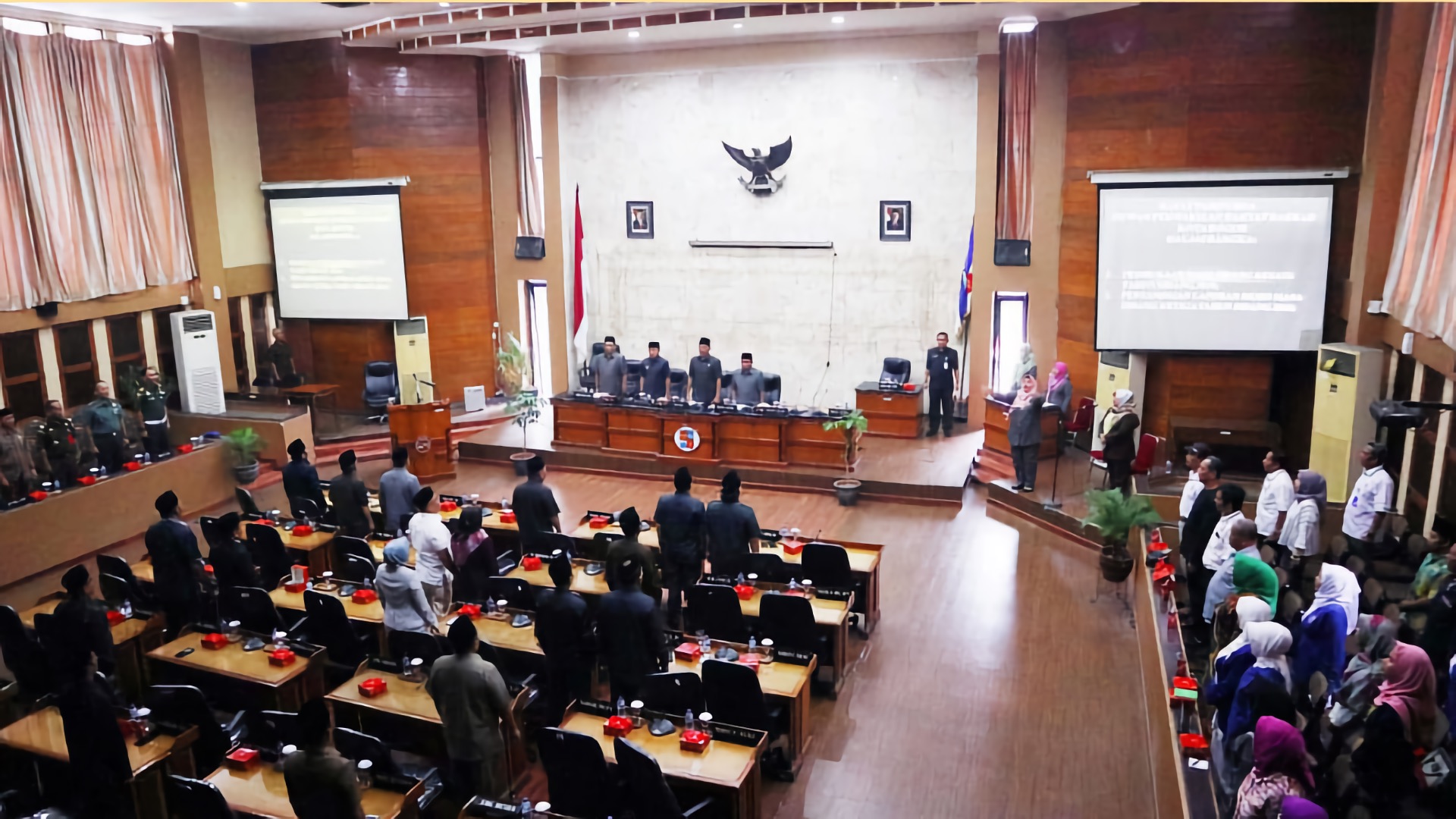
We, Kami Berani the Coalition of Civil Society on the Rights of Sexual Orientation and Gender Identity (SOGI) consist of Arus Pelangi, ASEAN SOGIE Caucus, Yayasan Lembaga Bantuan Hukum Indonesia (YLBHI), Lembaga Bantuan Hukum (LBH) Masyarakat, PKBI, SGRC Indonesia, Serikat Jurnalis untuk Keberagaman (SEJUK), Sanggar SWARA dan Human Rights Working Group (HRWG) together with the 141 undersigned organizations express our deepest concern on the new local regulation passed by the Bogor City Parliament, Indonesia. On December 21, 2021 the Bogor City Parliament and the Mayor of Bogor have passed a Local Regulation on the Prevention and Countermeasures of Sexual Deviant Behavior (P4S). The coalition considers that this regulation contains elements of human rights violations that aggravate violence and discrimination against Lesbian, Gay, Bisexual and Transgender groups in Bogor City. The reason, in Chapter III article 6 mentions that the group and behavior intend to be prevented are homosexual, lesbian and transgender.
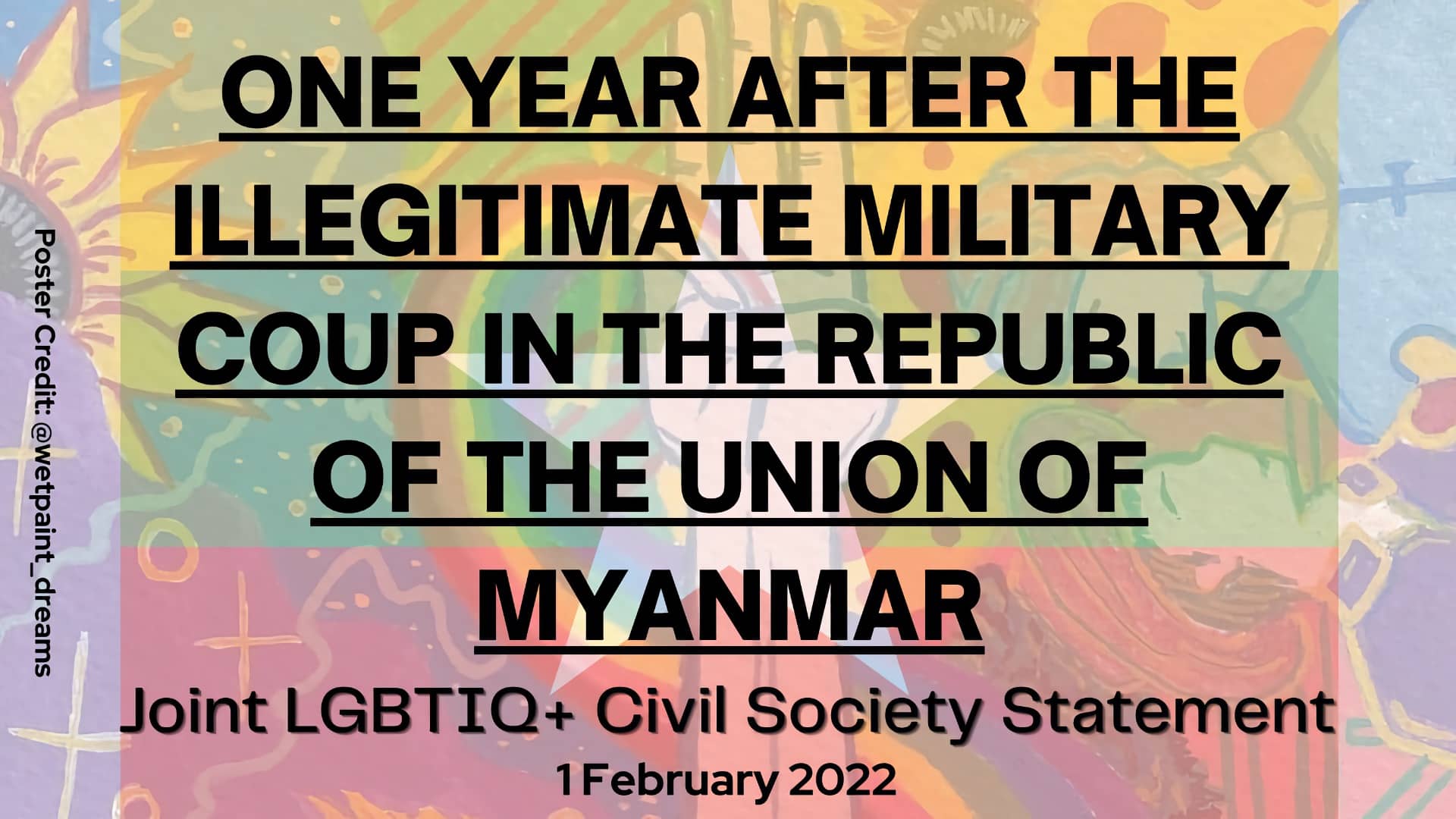
We will never forget. It has been a year since the violent and illegitimate occupation of the democratically elected government by Myanmar’s military junta on 1 February 2021. This was at a period when the people were at their most vulnerable, amid the COVID-19 pandemic. It was and still is a grave and utter betrayal of public will and trust, and a sheer disregard of democratic institutions and values.
ASEAN SOGIE Caucus Statement on International Human Rights Day 2021
Human rights violations are constantly faced by our queerblings in Southeast Asia, with ASEAN member states perpetuating and sponsoring the persecution of persons based on their sexual orientation, gender identity and expression, and sex charateristics (SOGIESC). In the middle of this year, Nur Sajat, a transgender woman was flown from Malaysia to Thailand for their safety, but was abducted by Thai authorities while waiting in transit for approval of her asylum. This September, some of our queersiblings in Municipality of Datu Piang, Maguindano in the Philippines were targeted and murdered. And recently, Thailand’s Constitutional Court denied equal marriage on the basis of heteronormative values, with the verdict stating that “the purpose of natural reproduction is to pass the race of nature between male and female, passing the property and creating a bond between father, mother, uncle, aunt, and grandparents. Meanwhile, marriage between the gender diverse may not be able to pass such a delicate bond.”
ASEAN SOGIE Caucus Statement on Thailand Constitutional Court Decision on Equal Marriage Petition
Thailand Constituional Court Verdict on the petition of equal marriage for all, filed by 2 queer Thai citizens and garnering more than 274,000 signatories, was met with anger and frustration from LGBTQIA human rights defenders, feminists, and pro-democracy activists. Moreover, this decision came out after Thailand’s Constitutional Court ruled that Section 1448 of the Civil and Commercial Code, which defined marriages as only between men and women, is constitutional.
We, the undersigned organisations working to advance the human rights of persons of diverse sexual orientation, gender identity and expression, and sex characteristics (SOGIESC) call for the protection of women, children, LGBTIQ people and other vulnerable persons in Afghanistan.
Since 15 August, the Taliban-led takeover of Kabul’s Presidential Palace and the abrupt collapse of the Islamic Republic of Afghanistan’s government raises concerns over human rights and the safety of marginalised groups in the country. Besides LGBTIQ people and people of diverse SOGIESC, women, persecuted religious minorities, journalists and human rights defenders have come under threat, and many have gone into hiding out of fear.
A Regional Statement of LGBTIQ+ Advocates from Southeast Asia[1]
We, the undersigned individual activists and organizations in Southeast Asia, are pushing for strategic steps towards an inclusive ASEAN region.
The advancement of the human rights of lesbian, gay, bisexual, transgender, intersex, queer, and other sexual and gender diverse (LGBTIQ+) persons in the Southeast Asia remains an challenging endeavour. ASEAN, having the mandate to protect and promote human rights for all persons as enshrined in its ASEAN Charter and the ASEAN Human Rights Declaration, have so far taken unremarkable steps to address our issues. As an institution, ASEAN restricts its very limited spaces for meaningful interaction and dialogue and alienating issues, advocacies, and identities which they perceive as sensitive or as not reflective of consensus among its member states.
Inclusive and diverse ASEAN
Legally Registered in the Philippines as Southeast Asia Sexual Orientation,
Gender Identity and Expression Caucus (ASC), Inc. The organization is in
Special Consultative Status with the UN ECOSOC since 2021.
Quezon City, Philippines
Email: communications@aseansogiecaucus.org
ASEAN SOGIE Caucus © 2026